Wednesday, March 22, 2023

Musical instrument: yue (龠)

Musical instrument:  yue
(龠)
compiled by David Badagnani (rev. 20 March 2026)

In an effort to make this information more accessible, this document contains resources related to the Chinese musical instrument flute called yuè (龠, 籥, or occasionally also 𠎤, the former being the earliest spelling), an oblique end-blown flute, played in a similar manner to the Turkish ney or Bulgarian kaval, which appeared in Chinese culture as early as the Neolithic period.

The modern character's construction has four parts:  人 + 一 + 口口口 + 冊, presumably depicting fingers (冊) pressing on finger holes (口).

The reconstructed Middle Chinese pronunciation is /jɨɐk̚/ (Zhengzhang) and the reconstructed Old Chinese pronunciations are /*lewk/ (Baxter-Sagart) or /*lowɢ/ (Zhengzhang).
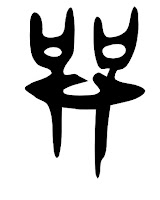
            

Ancient forms of the character for yue.
Left:  oracle bone script (used in the late 2nd millennium BC, mainly during the late Shang Dynaty)
Center:  bronze script, used from the Shang dynasty (2nd millennium BC) to the Zhou dynasty
(11th century BC-3rd century BC)
Right:  small seal script, based on the script of the state of Qin, systematized by Qin chancellor
Li Si (李斯) c. 220 BC and standardized by the Eastern Han Dynasty scholar Xu Shen (许慎)
in his Shuowen Jiezi《说文解字》, which was completed in 100 AD, and presented posthumously to
Emperor An of Han by Xu's son in 121 AD

According to Eastern Han Dynasty sources, 籟 (lài) was another name for the yue.

Ancient yue with five, six, seven, and eight finger holes, all made from the ulnas (wing bones) of red-crowned cranes (Chinese:  danding he, 丹顶鹤), some showing evidence of ancient repair or ancient fine pitch adjustment, and dating to approximately 7000 BC-5500 BC, during the Neolithic period, were excavated between the late 20th and early 21st centuries from the Jiahu archaeological site (贾湖遗址) in Jiahu Village (贾湖村), Beiwudu Town (北舞渡镇), Wuyang County (舞阳县), Luohe (漯河市), central Henan province, central China.  These instruments measure between 6.81 and 9.69 in. (17.3 and 24.6 cm) in length, and have a diameter of between 0.35 and 0.68 in. (0.9 and 1.72 cm).  The red-crowned crane is among the largest cranes, typically measuring about 5 feet tall, with a wingspan measuring between 7 and 8 feet.

Specimens of such Neolithic yue having been found at two different archaeological sites, they are referred to either as Jiahu gu di (賈湖骨龠, as discovered at the Jiahu archaeological site in Henan province) or Xinglongwa gu yue (興隆洼骨龠, from Aohan Banner, Chifeng, southeastern Inner Mongolia).

Yue with three finger holes were used in the court ritual music of the Zhou Dynasty, and continued in subsequent dynasties (and, indeed, all the way to the present day) to be used as a ritual implement in the dance accompanying Confucian ritual music.

Yue were used as a musical instrument in Confucian ritual ensembles as late as the Ming Dynasty.  As described in section 61 of the Ming Shi《明史》(The History of Ming):

其樂器之制,郊丘廟社,洪武元年定。
The rules for [the use of] musical instruments for suburban altars, temples, and shrines were finalized in the first year of the Hongwu reign.

樂工六十二人,編鐘、編磬各十六,琴十,瑟四,搏拊四,柷敔各一,壎四,篪四,簫八,笙八,笛四,應鼓一;歌工十二;協律郎一人執麾以引之。
There were 62 musicians:  16 each of bianzhong and bianqing, 10 qin, 4 se, 4 bofu, 1 each of zhu and yu, 4 xun, 4 chi, 8 xiao, 8 sheng, 4 di, [and] 1 yinggu; 12 singers; and one music master to lead them by holding a flag.

七年復增籥四,鳳笙四,壎用六,搏拊用二,共七十二人。
In the seventh year, four yue, four more feng sheng, six xun, and two bofu were added, for a total of 72 people.

舞則武舞生六十二人,引舞二人,各執干戚;文舞生六十二人,引舞二人,各執羽籥;舞師二人執節以引之。共一百三十人。
The dance consisted of 62 martial arts performers and 2 lead dancers, each wielding a shield and axe; 62 civil arts performers and 2 lead dancers, each wielding a [pheasant] feather [and] yue; [and] 2 dance masters who guided the dancers with staffs.  In total, there were 130 people.

http://www.guoxue123.com/Shibu/0101/00msf/061.htm

Two chou (籌) players from the Daxiangguo Temple Buddhist Music Ensemble (Daxiangguo Si Fanyuetuan,
大相国寺梵乐团), which is based at Daxiangguo Temple (Daxiangguo Si, 大相国寺), a historic Buddhist
temple in Kaifeng, east-central Henan province, central China.  Photo probably taken in 2011.

Similar instruments that are still used today in China include the chóu (籌), a rare bamboo flute that used to be used in Huangmei opera accompaniment and continues to be used in Buddhist ceremonial music of Henan province; the kexiju'er (克西举尔) or kexizhu'er (克西竹尔) of the Yi ethnic group of Liangshan Yi Autonomous Prefecture (凉山彝族自治州), southern Sichuan province, which is called yaodi (咬笛, literally "bitten flute") in Chinese, owing to the fact that it player anchors the rim of the blowing end between two of their top incisors while playing; and the yīngdí (鷹笛), a flute made from the wing bone of an eagle, which is used by the Tajik people of western China.

Contemporary performers who have worked to reconstruct and revive the ancient yue include the following:
● Mr. Liu Zhengguo (刘正国, b. Wuwei, Wuhu, southeastern Anhui province, east-central China, 1951), a professor from Shanghai Normal University who named this instrument after researching it since the early 1990s as "Jiahu bone yue" (Chinese:  Jiahu gu yue, 贾湖骨龠).  In 2015 he published a book entitled Zhongguo Gu Yue Kaolun《中国古龠考论》(Research on Chinese Ancient Yue)
● Mr. Yu Dongshen (于东波, b. Rudong County, Nantong, southeastern Jiangsu province, east-central China, 1981), who plays dizi, xiao, xun, and yue with the Nanjing Chinese Orchestra (南京民族乐团), and who is a protegé of Liu Zhengguo
● Mr. Chuai Zimo (揣子摩), a Bilibili user from China

It is presumed that the end-blown vertical flute called xiao (箫) or dongxiao (洞箫), with its U-shaped or V-shaped mouthpiece notch, represents a later development of the yue (the rim of the yue's blowing hole not having any kind of notch).

Links to textual sources are highlighted in green.

----------------------------------------------

Chinese historical reference works discussing the yue

● Erya《尔雅》(Warring States, Qin, and Western Han Dynasty)

《爾雅·釋樂》
「大籥謂之產,其中謂之仲,小者謂之箹。」

https://ctext.org/er-ya/shi-yue/zh#n38390

● Zhou Li《周礼》(The Rites of Zhou) (probably Western Han Dynasty)

「笙師:掌教吹竽、笙、塤、龠、簫、篪、笛、管,舂牘、應、雅,以教祴樂。凡祭祀、饗、射,共其鐘笙之樂,燕樂亦如之。大喪,廞其樂器;及喪,奉而藏之。」


● Shuowen Jiezi《說文解字》(Eastern Han Dynasty)

「龠:樂之竹管,三孔,以和眾聲也。从品、侖。侖,理也。凡龠之屬皆从龠。」


● Shuowen Jiezi《說文解字》(Eastern Han Dynasty)

「籟:三孔龠也。大者謂之笙,其中謂之籟,小者謂之箹。从竹賴聲。」

https://www.shuowen.org/view/2979

● Fengsu Tongyi《风俗通义》(Comprehensive Meaning of Customs and Mores or Comprehensive Meaning of Customs and Habits)
Also known as Fengsu Tong《风俗通》, this book was written by the politician, writer, and historian Ying Shao (应劭), who was a long-time close associate of Cao Cao, around 195 AD, during the late Eastern Han Dynasty.  The manuscript is similar to an almanac, which describes various strange and exotic matters of interest to the literati of the period, such as folk cultural practices, legends, mystical beliefs, and musical instruments.  There were originally a total of 30 chapters, but only 10 remain.  These chapters were recompiled by the Northern Song scientist Su Song (苏颂) from the works of Yu Zhongrong (庾仲容) and Ma Zong (马总).  Some fragments of the lost chapters exist as quotations in other Chinese texts.  The yue is discussed in the《聲音》chapter, as follows:

籥:

謹按:《周禮》:「籥師氏掌教國子吹籥。」《詩》云:「以籥不僣。」籥、樂之器竹管三孔,所以和眾聲也。

Additionally, the lai is discussed as follows:

籟

謹按:《禮·樂記》:「三孔籥也。大者謂之產,其中謂之仲,小者謂之箹。」


● Shiming《释名》(Explanation of Names)
A dictionary employing phonological glosses, which is believed to date from c. 200 AD, during the Eastern Han Dynasty.  There is controversy whether this dictionary's author was Liu Xi (刘熙, fl. c. 200 AD) or the more famous Liu Zhen (刘珍, d. 126 AD).  The yue is discussed in the section entitled "Explanation of Musical Instruments" (Shi Yueqi, 释乐器), as follows:
「籥,躍也,氣躍出也。」
https://ctext.org/shi-ming/shi-yue-qi

● Jiu Tang Shu《旧唐书》(The Old Book of Tang), also known simply as Tang Shu《唐书》(The Book of Tang)
This historical work in 200 volumes was completed in 945, actually during the Later Jin (后晋) Dynasty, one of the Five Dynasties during the Five Dynasties and Ten Kingdoms (五代十国) period following the fall of the Tang Dynasty.  It is one of the Twenty-Four Histories (二十四史).  The yue is discussed in Volume 29:

卷二十九
Volume 29

音樂二

「管三孔曰龠,春分之音,万物振跃而动也。」


---------------------------------------------

Chinese poems mentioning the yue

《景星》
作者:无名氏(汉)
Anonymous (Han Dynasty)

景星显见。信星彪列。
象载昭庭。日亲以察。
参侔开阖。爰推本纪。
汾脽出鼎。皇祜元始。
五音六律。依韦飨昭。
杂变并会。雅声远姚。
空桑琴瑟结信成。四兴迭代八风生。
殷殷钟石羽龠鸣。河龙供鲤醇牺牲。
百末旨酒布兰生。泰尊柘浆析朝酲。
微感心攸通修名。周流常羊思所并。
穰穰复正直往宁。冯蠵切和疏写平。
上天布施后土成。穰穰丰年四时荣。

More information:

---------------------------------------------

Bibliography

● Liu Zhengguo 刘正国.  Zhongguo Gu Yue Kaolun《中国古龠考论》[Research on Chinese Ancient Yue].  Shanghai:  Shanghai Joint Publishing 上海三联书店, 2015.

---------------------------------------------

Additional Web resources

● Ancient Chinese bone flutes (贾湖骨笛 / 贾湖骨龠 / 贾湖骨籥 / 兴隆洼骨龠) YouTube playlist (maintained by David Badagnani)

● Article about the chou (籌), as used by the Daxiangguo Temple Buddhist Music Ensemble (Daxiangguo Si Fanyuetuan, 大相国寺梵乐团), which is based at Daxiangguo Temple (Daxiangguo Si, 大相国寺), a historic Buddhist temple in Kaifeng, east-central Henan province, central China (China News Network, October 18, 2011):
https://www.sohu.com/a/20560587_121207

● Video of the Daxiangguo Temple Buddhist Music Ensemble (Daxiangguo Si Fanyuetuan, 大相国寺梵乐团), which is based at Daxiangguo Temple (Daxiangguo Si, 大相国寺), a historic Buddhist temple in Kaifeng, east-central Henan province, central China, featuring a player of the chou (籌) (filmed October 22, 2017)

● Article about yue player and scholar Liu Zhengguo (刘正国)

---------------------------------------------

Thanks to Lin Chiang-san and Wang Hong for assistance with this page.

---------------------------------------------

Site index:

Thursday, March 9, 2023

Tang-era piece: Chunying Zhuan《春鸎囀》

 Tang-era piece:  Chunying Zhuan
《春鸎囀》
compiled by David Badagnani (rev. 19 September 2026)

In an effort to make this information more accessible, this document contains resources related to the Tang-era piece entitled Chunying Zhuan《春鸎囀》or《春鶯囀》(The Singing of Spring Warblers or The Spring Warbler's Song), which exists in the form of instrumental parts for a suite in the Mixolydian mode on D, called Yue diao (越調) in Chinese and Ichikotsu-chō (壹越調) in Japanese.

As preserved in Sino-Japanese sources, this piece is called Shunnō-den『春鸎囀(しゅんのうてん)』, and it appears in the following score collections:
1) and 2) Sango Yōroku and Jinchi Yōroku, both of which were compiled in the late 12th century
3) Ruisō Chiyō『類箏治要』(1296 or c. 1261)

According to Chinese historical sources (including Jiaofang Ji and Yuefu Shiji), this suite, which is classified in Japanese historical sources as "new music" (Chinese:  新樂, xin yue; Japanese:  しんがく, shingaku), was composed by the court musician Bai Mingda (白明达), who was of Kuchean origin, during the reign of Emperor Gaozong (r. 628-683) in the early Tang Dynasty.  Its movement entitled "Bird Tune" (Chinese:  Niao Sheng, 鳥聲; Japanese:  Tesshо̄) is believed to have been inspired by the song of a Japanese bush warbler (Horornis diphone cantans, called uguisu, 鶯, in Japanese) that Gaozong heard once at dawn, then commanded Bai Mingda to copy it.

----------------------------------------------

Chinese historical sources mentioning Chunying Zhuan

● Jiaofang Ji《教坊记》(The Conservatory Records)
A collection of short essays by the Tang Dynasty scholar Cui Lingqin (崔令钦, fl. 749).  The title appears as《春鶯囀》.

● Jiegu Lu《羯鼓錄》
Jiegu Lu is a book on music in two parts by Nan Zhuo (南卓, fl. 848-850).  The first part was completed in 848 and the second in 850.  This piece appears as Huangying Zhuan《黃鶯囀》

● Tang Huiyao《唐会要》(Institutional History of Tang) This history of the Tang Dynasty, comprising 100 volumes and 514 sections, was compiled by Wang Pu (王溥, 922-982) and presented to Emperor Taizu, the founding emperor of the Song Dynasty, in 961.  This piece is mentioned in volume 33, where it appears as Chunying Zhuan Chui《春鶯囀吹》.

● Yuefu Shiji《乐府诗集》by Guo Maoqian (郭茂倩, 1041-1099)
The title appears in volume 47 as Huangying《黃纓》.

----------------------------------------------

Chinese poems and poetic lyrics mentioning Chunying Zhuan

《和李校书新题乐府十二首 其五 法曲》
作者:元稹(中唐)
by Yuan Zhen (mid-Tang Dynasty, 779-831)

吾闻黄帝鼓清角,弭伏熊罴舞玄鹤。
舜持干羽苗革心,尧用咸池凤巢阁。
大夏濩武皆象功,功多已讶玄功薄。
汉祖过沛亦有歌,秦王破阵非无作。
作之宗庙见艰难,作之军旅传糟粕。
明皇度曲多新态,宛转侵淫易沈著。
赤白桃李取花名,霓裳羽衣号天落。
雅弄虽云已变乱,夷音未得相参错。
自从胡骑起烟尘,毛毳腥膻满咸洛。
女为胡妇学胡妆,伎进胡音务胡乐。
火凤声沈多咽绝,春莺啭罢长萧索。
胡音胡骑与胡妆,五十年来竞纷泊。


*   *   *   *   *   *   *   *   *

《杂曲歌辞 春莺啭》
作者:张祜(唐)
by Zhang Hu (Tang Dynasty, c. 785-c. 849)

兴庆池南柳未开,太真先把一枝梅。
内人已唱春莺啭,花下傞傞软舞来。


《荆南席上咏胡琴妓二首》
Two Poems [About] Courtesans Singing [to the Accompaniment of] Barbarian Lutes at a Banquet in the [State of] Jingnan (Jingnan Xi Shang Yong Huqin Ji, Er Shou)
作者:王仁裕(唐末五代十国)
by Wang Renyu (late Tang Dynasty/Five Dynasties, 880-956)

其一
红妆齐抱紫檀槽,一抹朱弦四十条。
The red-made-up [ladies] together embrace [their instruments'] violet sandalwood soundboxes,
Each stroke on the vermilion strings [seemingly multiplied by] forty.
湘水凌波惭鼓瑟,秦楼明月罢吹箫。
[Amid the] rippling waves of the Xiang River, [the Goddesses] are too embarrassed to play the se,
While in the Tower of Qin, under a bright moon, [Nongyu and Xiao Shi] give up blowing their xiao.
寒敲白玉声偏婉,暖逼黄莺语自娇。
Cold taps on white jade [produce] a sound of rare and delicate beauty,
Warmly compelling the golden oriole to chirp sweetly to himself.
丹禁旧臣来侧耳,骨清神爽似闻韶。
In the cinnabar-painted Forbidden Palace, aged ministers incline their ears to listen,
[Their] bones cleansed and spirits refreshed, as if listening to the most sublime of ceremonies.

其二
玉纤挑落折冰声,散入秋空韵转清。
Delicate jade-white [fingers] flick upwards, then drop down, [producing] a sound like the snapping of ice,
Scattering into the autumn sky with lingering echoes that fade into nothingness.
二五指中句塞雁,十三弦上啭春莺。
[With the player's] two sets of five fingers [moving] amidst a curving line of wild geese from the northern frontier,
[She conjures] the twittering of spring warblers on [her] thirteen strings.
谱从陶室偷将妙,曲向秦楼写得成。
The score, stolen from the pottery studio, is eminently exquisite and profound;
Its melody, emanating from the Tower of Qin, is expressed in a fine and accomplished manner.
无限细腰宫里女,就中偏惬楚王情。
Immeasurably slender are the waists of the women in the palace,
And there is about them an uncommonly uninhibited and carefree [air that could] arouse the King of Chu's desire.

Notes:

● Jingnan (荆南), also known as Nanping (南平), 
was a small dynastic state with its capital at Jingzhou (荆州, modern-day south-central Hubei), which existed from 924 to 963, during the Five Dynasties and Ten Kingdoms period.
● "Huqin" (胡琴) refers here to plucked (rather than bowed) lutes of Central Asian, Turkic, or Middle Eastern origin.
● Silk musical instrument strings of the highest quality, called zhu xian (朱弦, literally "cinnabar/vermilion strings"), were red in color.
● The reference to the Xiang River is an allusion to the Goddesses of the Xiang River.  According to Bowu Zhi by Zhang Hua (张华, 232-300) of the Jin Dynasty, the legendary Chinese Emperor Shun (舜, who is said to have lived sometime between 2294 BC and 2184 BC) made an inspection tour of the south and died suddenly of an illness while in Cangwu, near the Xiang River in eastern Guangxi.  His wives Ehuang (娥皇) and Nüying (女英), the daughters of the legendary Emperor Yao, raced there and wailed in sorrow by the river for days, then drowned themselves, becoming the Goddesses of the Xiang River (Xiang Shui Shen, 湘水神), who are said to have played the se (瑟), a 25-stringed bridge zither that has been used in China to play court and ritual music since ancient times.  Qu Yuan's "Goddess of the Xiang River" and "Lady of Xiang" from the Chu Ci are likely based on this folklore.  The Xiang flowed into Dongting Lake through the ancient kingdom of Chu, whose songs in their worship have been recorded in a work attributed to Qu Yuan.
● The reference to the Tower of Qin is an allusion to the legend of Xiao Shi (萧史) and Nongyu (弄玉), the son-in-law and daughter of Duke Mu of Qin (秦穆公, r. 659 BC-621 BC, during the Spring and Autumn Period.  According to the legend, after the couple had retired to the seclusion of the middle peak of Mount Hua, one day Nongyu took her jade sheng and mounted a colorful phoenix, and Xiao Shi took his jade xiao and stepped onto a golden dragon.  For a time, the dragon and the phoenix flew into the air.  The so-called Tower of Qin (Qin Lou, 秦楼) was built by Duke Mu of Qin for his daughter Nongyu, and this term eventually acquired the additional metaphorical meaning of "brothel" (a place where music was often performed).  It seems likely that, in the first of the two poems, the original (historical) meaning is intended, whereas in the second poem the same term is used metaphorically to refer to the area of the Jingnan palace occupied by female courtesan-musicians.
● "Wen shao" (闻韶) is an allusion to the famous anecdote from the Analects in which Confucius was so overwhelmed by the beauty of the Shao (韶) ritual music of the State of Qi that "for three months he did not know the taste of meat."
● "Wild geese" (yan, 雁) refers to the bridges of the zheng, which are lined up in a diagonal row like a flock of wild geese in flight, and "thirteen strings" is a metonymic reference to the zheng (筝), a bridge zither with 12 or 13 silk strings, which enjoyed great popularity in the court music of the Tang Dynasty.
● The reference to the King of Chu is an allusion to King Ling of Chu (Chu Ling Wang, 楚灵王), the king of the State of Chu between 540 and 529 BC, with his capital at Ying (郢) near Jingzhou (荆州, modern-day south-central Hubei).  Lecherous by nature, he was famously fond of beauties with extremely thin waists, causing many of them to starve themselves in order to remain in his favor.  In the sixth year of his reign, he spent extravagantly to build his grand Zhanghua Palace (章华宫), where he lived a life of luxury, feasting and enjoying music and dance performances by a vast array of court maidens day and night.  A chengyu (4-character idiom) dating to the Yuan Dynasty, "Chu Guan Qin Lou" (楚馆秦楼), memorializes this king's reputation, using "Qin Lou" (秦楼) in its metaphorical sense to indicate that his palace was in essence a huge brothel.

题注:一作奉使荆南高从诲筵上听弹胡琴
其一:《十国春秋·高从诲世家注》载首二句,云是从诲作。

----------------------------------------------

Videos and recordings of Chunying Zhuan

● Recording of Chunying Zhuan (the full 10-movement suite), as supervised by Laurence Picken and performed by a small ensemble of gagaku instruments, with female vocalist (probably Tokyo, Japan, perhaps c. 1972)
https://sounds.bl.uk/search?q=Shunn%C5%8Dden (dead link)
● Studio recording of a movement of Chunying Zhuan by the Shanghai Chinese Ancient Music Ensemble (Shanghai, 1988); Chunying Zhuan starts at 29:14

● Cross-cultural performance of a movement of Chunying Zhuan by the Eurasia Consort (United States, 2016)
● Performance, with dance, of a movement of Chunying Zhuan by Xu Ge and his ensemble (China, 2019)

● Performance, with dance, of a movement of Chunying Zhuan by Xu Ge and his ensemble, with dance (China, 2019)

● Performance of a movement of Chunying Zhuan by Xu Ge and his ensemble (Weihai, Shandong province, China, 2020)

● Performance, with dance, of a movement of Chunying Zhuan by Xu Ge and his ensemble (Zhuhai, Guangdong province, China, 2020)
● Performance of a movement of Chunying Zhuan by Xu Ge and his ensemble (Beijing, 2021)
● Full-ensemble realization of Chunying Zhuan, done by Tokinori Yanagita using synthesized sounds (Japan, 2021) https://www.youtube.com/watch?v=mdWsw4JvrnI

● Full-ensemble realization of Chunying Zhuan, done by Tokinori Yanagita using synthesized sounds, revised version (Japan, 2021)

● Four movements from Chunying Zhuan, performed on bili and heng di by Bilibili user Beilin Zhai Zhuren (北林斋主人) (China, 2021)

● Full-ensemble realization of Chunying Zhuan, done by Tokinori Yanagita using synthesized sounds, revised version 2, with the modes of some movements changed (Japan, 2022)

● Ensemble version of Chunying Zhuan, performed by Bilibili user Beilin Zhai Zhuren (北林斋主人) (China, 2022)

● Realization of the pipa part of two movements of Chunying Zhuan by Bilibili user 雪狼的天空 using synthesized sounds (China, 2022)

● The ru po movement of Chunying Zhuan, performed on bili and heng di by Bilibili user Beilin Zhai Zhuren (北林斋主人) (China, 2023)

● The ru po movement of Chunying Zhuan, performed by Bilibili user Beilin Zhai Zhuren (北林斋主人), bili and heng di (China, 2023)

● Duo (xiao/guzheng) performance of Ye Dong's reconstruction of Chunying Zhuan by members of the Shanghai Guoyue Yanjiu Hui (上海国乐研究会, Shanghai National Music Research Association), which was established by Sun Yude (孙裕德, 1904-1981) in Shanghai in 1941 (China National Academy of Arts China Museum of Intangible Cultural Heritage 中国工艺美术馆·中国非物质文化遗产馆, Beijing, China, 2024)

● Ensemble performance of the jo and satto movements of Chunying Zhuan, as reconstructed by Laurence Picken, by the Eurasia Consort (United States, 2025)
----------------------------------------------

Bibliography

● Laurence Picken, ed., with Rembrandt F. Wolpert, Allan J. Marett, Jonathan Condit, and Elizabeth J. Markham, and with Yōko Mitani and Noël J. Nickson.  Music from the Tang Court, vol. 2.  Cambridge:  Cambridge University Press, 1985.

----------------------------------------------

Thanks to Qihan Liu for assistance with this page.

---------------------------------------------

Site index:
http://earlychinesemusic.blogspot.com/2020/04/site-index.html

Friday, March 3, 2023

Tang-era piece: Cao Po《曹婆》

 Tang-era piece:  Cao Po
《曹婆》
compiled by David Badagnani (rev. 5 July 2026)

In an effort to make this information more accessible, this document contains resources related to the Tang-era piece entitled Cao Po《曹婆》(Old Lady Cao), which is preserved in instrumental parts for a single-movement piece consisting of 17 measures of 2/2, in the Mixolydian mode on D, called Yue diao (越調) in Chinese and Ichikotsu-chō (壹越調) in Japanese.

As preserved in Sino-Japanese sources, this piece is called 
Sōba『曹婆(そうば)』, and it appears in the following score collections:
1) Kagaku ifu (13th century)
2) Shinsen Shōteki-fu (1302 or 1303)

The ethnomusicologist Stephen Jones (who was a pupil of Laurence Picken) points out that there was a musician named Cao Poluomen (曹婆罗门; "Poluomen" being Chinese for "Brahman") , who was originally from Kabudhan (called Caoguo 曹国 in Chinese) northeast of Samarkand, and served as a court musician during the Northern Wei Dynasty (386-534).  Many of his descendants went on to become prominent musicians.  Jones believes that the piece's title might be an abbreviation of "Cao Poluomen," but Picken states that "it seems somewhat improbable that 'Brahman Cao' should be associated with so slight a piece."

Rembrandt Wolpert, a former member of Laurence Picken's Tang Music Project, believes the surname Cao (曹) to derive from the Hindi surname Jhā (झा), which derives from the Sanskrit Upādhyāya (उपाध्याय, literally "teacher, preceptor, advisor, counselor"), a surname used by some Brahmin people in India.

----------------------------------------------

Chinese poems and poetic lyrics mentioning Cao Po

《追昔游》
(Zhui Xi You)
作者:元稹(中唐)
by Yuan Zhen (mid-Tang Dynasty, 779-831)

谢傅堂前音乐和,狗儿吹笛胆娘歌。
花园欲盛千场饮,水阁初成百度过。
醉摘樱桃投小玉,懒梳丛鬓舞曹婆。
再来门馆唯相吊,风落秋池红叶多。

Notes:

This poem was written in Luoyang in the year 809.  Located about 350 km east of Chang'an, Luoyang (洛阳), in Henan province, flourished as the second city and eastern capital of the Tang Dynasty, and at its height it had a population of around one million, second only to Chang'an, which, at the time, was the largest city in the world.

《阿曹婆辞 镇陇西三首 其一 第一》(敦煌曲子), anonymous Tang-era poetic lyrics from Dunhuang

昨夜春风入户来。
动人怀。
祗见庭前花欲发。
半含咍。
直为思君容貌改。
征夫镇在陇西坏。
正见庭前双鹊喜。
君在塞外远征回。
梦先来。

《阿曹婆辞 镇陇西三首 其二 第二》(敦煌曲子), anonymous Tang-era poetic lyrics from Dunhuang

独坐幽闺思转多。
意如何。
秋夜更长难可度。
慢怜他。
每恨狂夫薄行迹。
一从征出镇蹉跎。
直为思君容貌改。
疆场还道□□□。
□□□。

《阿曹婆辞 镇陇西三首 其三 第三》(敦煌曲子), anonymous Tang-era poetic lyrics from Dunhuang

当本祗言三载归。
灼灼期。
朝暮啼多淹损眼。
信音稀。
妾守空闺恒独寝。
君在塞北亦应知。
懊恼无辞呈肝胆。
留心会合待明时。
□□□。

----------------------------------------------

Videos and recordings of Cao Po
● Electronic realization of a Lydian solo pipa version of Cao Po, done by Tokinori Yanagita using synthesized sounds (Japan, 2021) https://www.youtube.com/watch?v=MPzz9ZhbO2Q&t=60s
● Small-ensemble realization of a Lydian version of Cao Po, done by Tokinori Yanagita using synthesized sounds (Japan, 2021) https://www.youtube.com/watch?v=TffWMozz4Jg ● Small-ensemble realization of a Lydian version of Cao Po, done by Tokinori Yanagita using synthesized sounds, revised version (Japan, 2022) https://www.youtube.com/watch?v=Sn3lSHu7FqE ● Electronic realization of Cao Po, in three full-ensemble versions, by YouTube user 古樂尋蹤_HGofACH (Canada, 2022)

----------------------------------------------

Bibliography

● Laurence Picken, ed., with Rembrandt F. Wolpert, Allan J. Marett, Jonathan Condit, and Elizabeth J. Markham, and with Yōko Mitani and Noël J. Nickson.  Music from the Tang Court, vol. 4.  Cambridge:  Cambridge University Press, 1987, pp. 113-114. ● Laurence Picken and Noël J. Nickson, eds., with Rembrandt F. Wolpert, Allan J. Marett, Elizabeth J. Markham, Yōko Mitani, and Stephen Jones. Music from the Tang Court, vol. 5. Cambridge: Cambridge University Press, 1990.

----------------------------------------------

Site index:

Sunday, September 4, 2022

Musical instrument: ji ou (擊甌)

Musical instrument:  ji ou
(擊甌)
compiled by David Badagnani (rev. 27 September 2026)
An illustration of a ji ou from from Chapter 137 of a Qing Dynasty edition of the Northern Song Dynasty musicological treatise Yue Shu《乐书》(The Book of Music) by Chen Yang (陈旸, 1064-1128).  Completed in 1104 and consisting of 200 chapters, it was the first Chinese encyclopedia of music.

In an effort to make this information more accessible, this document contains resources related to the Chinese sound-producing device called ji ou (擊甌, literally "struck ou," an ou 甌 being a small porcelain drinking cup or bowl used to hold wine, tea, water, or other liquids), also known as ji fou (擊缶), ba fou (八缶), shui zhan (水盞), fouqin (缶琴), or wanqin (碗琴)--a set of water-tuned porcelain bowls played with a pair of sticks as a melodic percussion instrument.  The term shui zhan first appeared in the Northern Song Dynasty (continuing to be used through the Yuan and Ming dynasties), and in the late Qing Dynasty the term fouqin (缶琴) was used.  In the modern day, this instrument (which continues to be used to a limited extent) is usually referred to as wanqin (碗琴), and in 1985 the Jiangxi Jingdezhen City Song and Dance Troupe (江西景德镇市歌舞团) introduced a newly developed type of ji ou called ci ou (瓷瓯).

This instrument type probably derives from earlier Chinese percussion instruments made of pottery wine vessels such as the fou (缶), pen (盆), weng (瓮), and ling (瓴), which existed since the pre-Qin period, and which were generally used singly to provide a simple rhythmic accompaniment to singing or dancing; such practice continued through the Six Dynasties period.

In the Sui-Tang period, this concept was extended to create a set of porcelain bowls that could be played as a solo instrument, and by the Tang Dynasty the sound of this instrument, in skilled hands, was considered by such musician-scholars as Duan Anjie (段安节, fl. 880-898) to rival that of the fangxiang metallophone.

During the Tang Dynasty, the ji ou was popular in both court entertainment music as well as played as a folk instrument by the common people.  In southern China, the porcelain bowls used for the ji ou were produced in the Yue kiln (越窑), located in Yuezhou (modern-day Shaoxing, Zhejiang province), and in southern China they were made in the Xing kiln (邢窑), which was located in Xingzhou (modern-day Xingtai, southern Hebei province).  Of these, the bowls produced by the Yue kiln, called Yue ware (Yue qi, 越器), were considered of particularly high quality.  In his Cha Jing《茶经》(The Classic of Tea), Lu Yu (733-804) described teacups produced in the Yue kiln as "like jade, like ice"「类玉、类冰」, and those made by the Xing kiln as "like silver, like snow"「类银、类雪」.

In some cases (as in the Yuan Dynasty), the cups or bowls of a ji ou were made from bronze; in this case, they were called tong ou (铜瓯).

Instruments deriving from the ji ou may also be found in other Asian nations, including India (where it is called jal tarang), Japan (where it is called wankin, 碗琴 / わんきん), Vietnam, Java, Bali, and Burma.

Links to textual sources are highlighted in green.

----------------------------------------------

Chinese historical reference works discussing the ji ou

● Yuefu Zalu《乐府杂录》(Miscellaneous Notes Regarding the Music Bureau)
A collection of small essays (biji, 笔记) by the scholar Duan Anjie (段安节, fl. 880-898), published around 890 near the end of the Tang Dynasty.  This work survives in no fewer than 23 different editions.  An extensively annotated German translation was published by Martin Gimm (b. 1930) in 1966.  It includes a section on the ji ou (the time period described in this passage being 840-846):

「武宗朝,郭道源後爲鳳翔府天興縣丞,充太常寺調音律官,善擊甌,率以邢甌越甌共十二隻,旋加減水於其中,以筋擊之,其音妙于方響也。咸通中有吳繽,洞曉音律,亦爲鼓吹署丞,充調音律官,善於擊甌。擊甌,蓋出於擊缶。」


● Jiu Tang Shu《旧唐书》(The Old Book of Tang), also known simply as Tang Shu《唐书》(The Book of Tang)
This historical work in 200 volumes was completed in 945, actually during the Later Jin (后晋) Dynasty, one of the Five Dynasties during the Five Dynasties and Ten Kingdoms (五代十国) period following the fall of the Tang Dynasty.  It is one of the Twenty-Four Histories (二十四史).  The ba fou is described as follows:

「八缶,唐永泰初司馬縚進廣平樂,蓋八缶具黃鐘一均聲。」


● Taiping Yulan《太平御览》, an encyclopedia of general knowledge compiled by a committee of officials coordinated by Li Fang from 977 to 983
Considered one of the Four Great Books of Song, this huge leishu encyclopedia was commissioned by the imperial court of the Song dynasty during the first era of the reign of Emperor Taizong.  It is divided into 1,000 volumes and 55 sections, which consist of about 4.7 million Chinese characters.  Music is covered in a section entitled "Music Division" (Yuebu, 乐部), beginning with Yuebu 1 (乐部一) in chapter 563 and ending with Yuebu 22 (乐部二十二) in chapter 584.  The ba fou and ji ou are mentioned in chapter 584, as follows:

缶

《大周正乐》曰:今缶八。永泰初,司马滔进献广平乐,兼此八缶,具黄锺一均声。

《乐府杂录》曰:唐大中初,有调音律官天兴县丞郭道源,善击瓯。用越瓯、邢瓯共一十二旋,加减水,以箸击之,其音妙于方响也。


● Yue Shu《乐书》(The Book of Music/Monograph on Music) by Chen Yang (陈旸, 1064-1128)
Completed in 1104, during the late Northern Song Dynasty, and consisting of 200 chapters, Yue Shu was the first Chinese encyclopedia of music.  Since then it has been published in many different editions.  The ba fou, shui zhan, and ji ou are illustrated and described in chapter 137:

Description of ba fou:
唐永泰初,司馬淊進廣平樂,蓋有八缶,具黃鐘一均。聲亦在所可取矣

Description of shui zhan:
「近世民間用九甌,盛水擊之,謂之水盞。合五聲四清之音,蓋其制始于李琬,特世俗之樂,非雅調也。」

Description of ji ou:
唐武宗大中初,天興縣丞郭道源取邢甌十二,酌水作調,以著擊之,其音妙於方響。咸通中,吳蠙亦精於此。劉安曰:窮鄉之社,扣甕拊瓴,相和而歌以為樂,豈 亦擊甌類歟?非古制也。自擊建鼓,撞巨鐘觀之,則扣 甕拊瓴之樂,亦足羞矣。《墨子》曰:「農夫息於聆缶之樂」, 亦此類歟?

Another version of the above passage:
唐武宗大中初,天兴县丞郭道源取邢瓯、越瓯十二,酌水作调,以箸击之,其音妙于方响。咸通中,吴蠙亦精于此。


● Shiwu Jiyuan《事物纪原》(Compound Source of Matters and Facts)
Shiwu Jiyuan is an encyclopedia comprising ten volumes, which was completed in 1197, during the Southern Song Dynasty.  The ji ou is described as follows:

击瓯

吕氏春秋曰尧使质以麋络鱼缶而鼓之诗宛丘曰坎其击缶史记秦赵会渑池秦王击缶则古有击缶为乐者。击瓯,盖击缶之遗事也。唐大中初,郭道源善之,用越瓯、邢瓯十二,旋加减水,以箸击之,其音妙于方响。昔人于此记其法,疑其自道源始也。


● Ducheng Jisheng《都城纪胜》(Record of the Splendors of the Capital City)
A description of the Southern Song Dynasty capital of Lin'an (Hangzhou), published in 1235 by Nai Deweng (耐得翁), a scholar who had once traveled to the city and wrote down what he observed.  The shui zhan is described as follows:

「小樂器只一二人合動也,如雙韻合阮咸,稽琴合簫管,鍫琴合葫蘆琴。單撥十四絃,吹賺動鼓板。渤海樂一拍子,至於十拍子。又有拍番鼓子,敲水盞、鑼板、和鼓兒,皆是也。」

An alternate version of the above passage:
「小乐器只一二人合动也,如双韵合阮咸,稽琴合箫管,琴合葫芦。琴单拨十四弦,吹赚动鼓板,渤海乐一拍子,至于拍番鼓子、敲水盏锣板和鼓儿,皆是也。今街市有乐人三五为队,专赶春场,看潮,赏芙蓉,及酒坐祗应,与钱亦不多,谓之荒鼓板。」


● Meng Liang Lu《梦粱录》(A Dream of Sorghum)
This 20-volume book by Wu Zimu (吴自牧, dates of birth and death unknown) describes the city of Lin'an (modern-day Hangzhou) during the Southern Song Dynasty.  The shui zhan is described in Chapter 20, as follows:

妓乐

散乐传学教坊十三部,惟以杂剧为正色。旧教坊有筚篥部、大鼓部、拍板部。色有歌板色、琵琶色、筝色、方响色、笙色、龙笛色、头管色、舞旋色、杂剧色、参军等色。但色有色长、部有部头。上有教坊使、副钤辖、都管、掌仪、掌范,皆是杂流命官。其诸部诸色,分服紫、绯、绿三色宽衫,两下各垂黄义。杂剧部皆诨裹,余皆幞头帽子。更有小儿队、女童采莲队。其外别有钧容班人,四孟乘马从驾后动乐者是也。御马院使臣,凡有宣唤或御教,入内承应奏乐。绍兴年间,废教坊职名,如遇大朝会、圣节,御前排当及驾前导引奏乐,并拨临安府衙前乐人,属修内司教乐所集定姓名,以奉御前供应。向者汴京教坊大使孟角球曾做杂剧本子,葛守诚撰四十大曲,丁仙现捷才知音。南渡以后,教坊有丁汉弼、杨国祥等。景定年间至咸淳岁,衙前乐拨充教乐所都管、部头、色长等人员,如陆恩显、时和、王见喜、何雁喜、王吉、赵和、金宝、范宗茂、傅昌祖、张文贵、侯端、朱尧卿、周国保、王荣显等。且谓杂剧中末泥为长,每一场四人或五人。先做寻常熟事一段,名曰"艳段"。次做正杂剧、通名两段。末泥色主张,引戏色分付,副净色发乔,副末色打诨。或添一人,名曰"装孤"。先吹曲,破断送,谓之"把色"。大抵全以故事,务在滑稽唱念,应对通遍。此本是鉴戒,又隐于谏诤,故从便跣露,谓之"无过虫"耳。若欲驾前承应,亦无责罚。一时取圣颜笑。凡有谏诤,或谏官陈事,上不从,则此辈妆做故事,隐其情而谏之,于上颜亦无怒也。又有杂扮,或曰"杂班",又名"经元子",又谓之"拔和",即杂剧之后散段也。顷在汴京时,村落野夫,罕得入城,遂撰此端。多是借装为山东、河北村叟,以资笑端。今士庶多以从省,筵会或社会,皆用融和坊、新街及下瓦子等处散乐家,女童装末,加以弦索赚曲,祗应而已。大凡动细乐,比之大乐,则不用大鼓、杖鼓、羯鼓、头管、琵琶等,每只以箫、笙、筚篥、嵇琴、方响,其音韵清且美也。若合动小乐器,只三二人合动尤佳,如双韵合阮咸,嵇琴合箫管,琴合葫芦琴,或弹拨下四弦,独打方响,吹赚动鼓《渤海乐》一拍子至十拍子。又有拍番鼓儿,敲水盏,打锣板,和鼓儿,皆是也。街市有乐人三五为队,擎一二女童舞旋,唱小词,专沿街赶趁。元夕放灯、三春园馆赏玩、及游湖看潮之时,或于酒楼,或花衢柳巷妓馆家祗应,但犒钱亦不多,谓之"荒鼓板"。若论动清音,比马后乐加方响、笙与龙笛,用小提鼓,其声音亦清细轻雅,殊可人听。更有小唱、唱叫、执板、慢曲、曲破,大率轻起重杀,正谓之"浅斟低唱"。若舞四十六大曲,皆为一体。但唱令曲小词,须是声音软美,与叫果子、唱耍令不犯腔一同也。朝廷御宴,是歌板色承应。如府第富户,多于邪街等处,择其能讴妓女,顾倩祗应。或官府公筵及三学斋会、缙绅同年会、乡会,皆官差诸库角妓祗直。自景定以来,诸酒库设法卖酒,官妓及私名妓女数内,拣择上中甲者,委有娉婷秀媚,桃脸樱唇,玉指纤纤,秋波滴溜,歌喉宛转,道得字真韵正,令人侧耳听之不厌。官妓如金赛兰、范都宜、唐安安、倪都惜、潘称心、梅丑儿、钱保奴、吕作娘、康三娘、桃师姑、沈三如等,及私各妓女如苏州钱三姐、七姐、文字季惜惜、鼓板朱一姐、媳妇朱三姐、吕双双、十般大胡怜怜、婺州张七姐、蛮王二姐、搭罗邱三姐、一丈白杨三妈、旧司马二娘、裱背陈三妈、屐片张三娘、半把伞朱七姐、轿番王四姐、大臂吴三妈、浴堂徐六妈、沈盼盼、普安安、徐双双、彭新等。后辈虽有歌唱者,比之前辈,终不如也。说唱诸宫调,昨汴京有孔三传编成传奇灵怪,入曲说唱;今杭城有女流熊保保及后辈女童皆效此,说唱亦精,于上鼓板无二也。盖嘌唱为引子四句就入者谓之"下影带"。无影带,名为"散呼"。若不上鼓面,止敲盏儿,谓之"打拍"。唱赚在京时,只有缠令、缠达。有引子、尾声为缠令。引子后只有两腔迎互循环,间有缠达。绍兴年间,有张五牛大夫,因听动鼓板中有《太平令》或赚鼓板,即今拍板大节抑扬处是也,遂撰为"赚"。赚者,误赚之之义也,正堪美听中,不觉已至尾声,是不宜为片序也。又有"覆赚",其中变花前月下之情及铁骑之类。今杭城老成能唱赚者,如窦四官人、离七官人、周竹窗、东西两陈九郎、包都事、香沈二郎、雕花杨一郎、招六郎、沈妈妈等。凡唱赚最难,兼慢曲、曲破、大曲、嘌唱、耍令、番曲、叫声,接诸家腔谱也。若唱嘌耍令,今者如路岐人、王双莲、吕大夫唱得音律端正耳。今街市与宅院,往往效京师叫声,以市井诸色歌叫卖物之声,采合宫商成其词也。

http://www.guoxue123.com/shibu/0301/00mll/021.htm

● Wenxian Tongkao《文献通考》(Comprehensive Examination of Literature)
Compiled in the early 14th century, during the Yuan Dynasty, by Ma Duanlin (马端临), this work contains a list and descriptions of many ancient and Medieval musical instruments.  There are no illustrations.  The shui zhan and ji ou are described in Chapter 135, as follows:

水盞

近世民閒用九甌盛水擊之,謂之“水盞”。合五聲四清之音,其制蓋始於李琬,特世俗之樂,非雅調也。

拊瓶 扣瓮 击瓯 [以十二磁甌為一棹]

唐武宗大中初,天兴县丞郭道源取邢瓯、越瓯十二,酌水作调,以箸击之,其音妙于方响。咸通中,吴蠙亦精于此。

Another version of the above passage:
拊瓶 扣甕 擊甌
唐武宗大中初,天興縣丞郭道源取邢甌越甌十二酌水作調,以著擊之,其音妙於方響。咸通中,吳亦精於此。


● Yuan Shi《元史》(The History of Yuan)
The official history of the Yuan Dynasty (1271-1368), Yuan Shi was completed in 1370 (actually during the early Ming Dynasty).  It is one of the Twenty-Four Histories (二十四史).  The shui zhan is described in volume 71, as follows:

宴樂之器

水盞,制以銅,凡十有二,擊以鐵箸。


● Sancai Tuhui《三才图会》(Illustrations of the Three Powers)
Compiled by Wang Qi (王圻) and his son Wang Siyi (王思義), Sancai Tuhui is a Chinese leishu encyclopedia, completed in 1607 and published in 1609 during the late Ming dynasty, featuring illustrations of subjects in the three worlds of heaven, earth, and humanity. This work includes an illustration of a ji ou, which may be found in the following section:
卷之三,「器用三卷」當中的樂器類,第三十四頁,與拍板圖放在一起。


● Ming Shi《明史》(The History of Ming)
The official history of the Ming Dynasty (1368-1644), Ming Shi was completed in 1739 (actually during the Qing Dynasty).  It is one of the Twenty-Four Histories (二十四史).  The shui zhan is listed in volume 61 as being one of the instruments used in the Ming court's Si Yi Wu Yue (四夷舞樂, Music and Dance of the Four Barbarian Peoples), which originated from the Mongol tribes of Wuliangha Sanwei, on China's northeastern frontier, which fell under China's control following the retreat of the Yuan Dynasty following their defeat at the hands of the Ming Dynasty in 1368:

大宴。洪武元年定殿內侑食樂:簫六,笙六,歌工四。丹陛大樂:戲竹二,簫四,笙四,琵琶六,𥱧六,箜篌四,方響四,頭管四,龍笛四,杖鼓二十四,大鼓二,板二。文武二舞樂器:笙二,橫管二,𥱧二,杖鼓二,大鼓一,板一。四夷舞樂:腰鼓二,琵琶二,胡琴二,箜篌二,頭管二,羌笛二,𥱧二,水盞一,板一。


● Gujin Tushu Jicheng《古今图书集成》(Complete Collection of Illustrations and Writings from the Earliest to Current Times)
This massive encyclopedia comprising 10,000 volumes was written during the reigns of the Qing Dynasty emperors Kangxi and Yongzheng.  The work, was begun in 1700 and completed in 1725, was supervised initially by Chen Menglei (陈梦雷, 1650-1741), and later by Jiang Tingxi (蒋廷锡, 1669-1732).  The ji ou is described as follows:

---------------------------------------------

Other Chinese literary works mentioning the ji ou

● Feiyan Zhuan《非烟传》
Feiyan Zhuan is an anonymous novel composed during the Tang Dynasty, whose heroine is a skilled player of the ji ou.  This instrument is mentioned in the second sentence of the novel, as follows:

「临淮武公业,咸通中,任河南府功曹参军。爱妾曰非烟,姓步氏,容止纤丽,若不胜绮罗;善秦声,好文笔,尤工击瓯,其韵与丝竹合。」


---------------------------------------------

Chinese poems mentioning the ji ou

《李户曹小妓天得善击越器以成曲章》
Little Courtesan Li Hucao, With Her Heaven-Bestowed Talent in Hitting Yue Ware [Bowls], Uses Them to Realize a Movement of a Piece (Li Hucao Xiao Ji Tian De Shan Ji Yue Qi Yi Cheng Qu Zhang)
作者:方干(唐)
by Fang Gan (Tang Dynasty, 809-888, 886, 885, 882, or 873)

越器敲来曲调成,腕头匀滑自轻清。
Yue ware is tapped, creating a melody,
Her hands, with even and smooth [motions], [producing a sound that is] light and crisp.
随风摇曳有馀韵,测水浅深多泛声。
Carried by the breeze, it has a lingering charm,
And the measurement of the water [in the cups]--whether shallow or deep--creates an overflowing profusion of tones.
昼漏丁当相续滴,寒蝉计会一时鸣。
Like the "ding-dong" of a water clock with its successive drops,
Or cold cicadas counting together the interval of their calls.
若教进上梨园去,众乐无由更擅名。
If [she should] advance and depart for the Pear Garden,
Those who love her music will have no way to replace her skill and reputation.

Notes:

Fang Gan was a scholar and poet from Zhejiang province.  In southern China during the Tang Dynasty, the porcelain bowls used for the ji ou (击瓯, a set of water-tuned porcelain bowls played with a pair of sticks as a melodic percussion instrument) were produced in the Yue kiln (越窑), located in Yuezhou (modern-day Shaoxing, Zhejiang province).  Referred to as Yue ware (Yue qi, 越器), such bowls were considered of particularly high quality, and, in his Cha Jing《茶经》(The Classic of Tea), Lu Yu (733-804) described teacups produced in the Yue kiln as "like jade, like ice"「类玉、类冰」.  The Pear Garden (Chinese:  Liyuan, 梨园) was an academy for court entertainment music, dance, and theater, which was established in the Tang Dynasty capital of Chang'an by Emperor Xuanzong (r. 712-756).

*   *   *   *   *   *   *   *   *

《赠李粲秀才(字辉用)》
作者:僧鸾(唐末)
by Sengluan (late Tang Dynasty)

陇西辉用真才子,搜奇探险无伦比。
笔下铦磨巨阙锋,胸中静滟西江水。
哀弦古乐清人耳,月露激寒哭秋鬼。
苔地无尘到晓吟,杉松老叶风乾起。
十轴示余三百篇,金碧烂光烧蜀笺。
雄芒逸气测不得,使我踯躅成狂颠。
大郊远阔空无边,凝明淡绿收馀烟。
旷怀相对景何限,落日乱峰青倚天。
又惊大舶帆高悬,行涛劈浪凌飞仙。
回首瞥见五千仞,扑下香炉瀑布泉。
何事古人誇八斗,焉敢今朝定妍丑。
飒风驱雷暂不停,始向场中称大手。
骏如健鹘鹗与雕,拿云猎野翻重霄。
狐狸窜伏不敢动,却下双鸣当迅飙。
愁如湘灵哭湘浦,咽咽哀音隔云雾。
九嶷深翠转巍峨,仙骨寒消不知处。
清同野客敲越瓯,丁当急响涵清秋。
鸾雏相引叫未定,霜结夜阑仍在楼。
高若太空露云物,片白激青皆彷佛。
仙鹤闲从净碧飞,巨鳌头戴蓬莱出。
前辈歌诗惟翰林,神仙老格何高深。
鞭驰造化绕笔转,灿烂不为酸苦吟。
梦乘明月清沈沈,飞到天台天姥岑。
倾湖涌海数百字,字字不朽长摐金。
此日多君可俦侣,堆珠叠玑满玄圃。
终日并辔游昆崙,十二楼中宴王母。


*   *   *   *   *   *   *   *   *

《郭处士击瓯歌》
作者:温庭筠(唐)
by Wen Tingyun (Tang Dynasty, c. 812-c. 866 or 870)

佶栗金虬石潭古,勺陂潋滟幽修语。
湘君宝马上神云,碎佩丛铃满烟雨。
吾闻三十六宫花离离,软风吹春星斗稀。
玉晨冷磬破昏梦,天露未干香著衣。
兰钗委坠垂云发,小响丁当逐回雪。
晴碧烟滋重叠山,罗屏半掩桃花月。
太平天子驻云车,龙炉勃郁双蟠拏。
宫中近臣抱扇立,侍女低鬟落翠花。
乱珠触续正跳荡,倾头不觉金乌斜。
我亦为君长叹息,缄情远寄愁无色。
莫沾香梦绿杨丝。千里春风正无力。

Notes:

This poem was inspired by Wen Tingyun hearing a performance by the court musician Guo Daoyuan (郭道源), who was a skilled player of the ji ou, sometime between 840 and 846.


*   *   *   *   *   *   *   *   *

《击瓯赋》(有序)
作者:张曙(唐)
by Zhang Shu (Tang Dynasty)

宋玉《九辩》曰:“悼馀生之不时也。”甲辰,窜身巴南,避许溃师。郡刺史甚欢接春。一日登郡东楼,下临巴江,馔酒簇乐,以相为娱。言间有马处士末至,善击瓯者。请即清宴,爰骋妙绝。处士审音以知声,馀审乐以知化。斯可以抑扬淫放,顿挫匏竹,运动节奏,出鬼入神。太守请馀赋之。馀曰:“不图为乐之至于斯。”酒酣舐笔,乃为赋云:

器之为质兮白而贞,水之为性兮柔而清。水投器而有象,器藉水而成声。始因心而度曲,俄应手以征情。莫不敲萧熠爚,撇捩纵横。胡不自匏丝而起,胡不从金石而生。孰谓节奏,乐我生平。何彼秾矣,高楼燕喜。叩寂含商,穷元咀征。拂绮井以连骞,送枫汀之靡迤。岩隈有雪,彪咻而雕虎扬睛。潭上无风,捷猎而金蚪跋尾。目运心语,波回浪旋。似欲奋而还驻,若将穷而复连。得不似惊沙叫雁,高柳鸣蝉。董双成青琐鸾饥,啄开珠网。穆天子红缰马解,踏破琼田。愕眙衡盱,神清调古。既嗟叹之不足,谅悲哀以为主。誓不向单于台畔,和塞叶胡笳。定不入宋玉筵中,随齐竽楚舞。疾徐奋袂,曲折萦组。潺湲下陇底之泉,呜咽上涔阳之橹。莺隔溪而对语,一浦花红。猿袅树以哀吟,千山月午。斯皆从有入无,妙动元枢。滟飐则水心云母,丁当则杖杪真珠。于是发春卉,骇灵姝。羞杀兮钿筝金铎,愁闻兮鬼啸神呼。时也曲阕酒阑,烟遂雾隔。览故步以踯躅,有馀声而滴沥。临流而欲去依依,转首而相看脉脉。太守曰:“遘止良辰,好乐还淳。讽赋已劳于进牍,讴歌为序其芳尘。”馀乃歌曰:“江风起兮江楼春,千里万里兮愁杀人。楼前芳草兮关山道,江上孤帆兮杨柳津。是何况我兮击拊,眷我兮殷勤。”回首而渔翁鼓枻,凝眸而思妇沾巾。夫当筵一曲,人生一世。何纷糅乎是非,顾何慕乎隆替。飘缨宜入醉乡来,自识天人之际。


*   *   *   *   *   *   *   *   *

《句 其一》
作者:冯介(北宋)
by Feng Jie (Northern Song Dynasty)

白云处士来观乐,翠黛佳人笑击瓯。

*   *   *   *   *   *   *   *   *

《句 其二》
作者:冯介(北宋)
by Feng Jie (Northern Song Dynasty)

坐上击瓯清似玉,槛前流水碧如蓝。

*   *   *   *   *   *   *   *   *

《击瓯赋》
(Ji Ou Fu)
作者:梅尧臣(北宋)
by Mei Yaochen (Northern Song Dynasty, 1002-1060)

余观今乐,爱乎清越出金石之间,所谓击瓯者,本埏埴,异琳球,入伶伦兮间齐优。其可尚者,鸣非瓦釜律度合,鼓非土缶音韵周,和非埙篪上下应,作非锺罄节奏侔,而又冰质莹然,水声修然,度曲泠然,入耳浏然。犹有非之者曰:“善则善矣,未若艳女之歌喉。何则?是谓丝不如竹,竹不如肉,以其近自然之气,况此曾何参于乐录之目乎!”余辩之曰:“融结合于造化,坚白播于陶钧,发和于器,导和于人,可以乐嘉宾,可以畅百神,安得丝竹讴吟之匪伦也哉!”


*   *   *   *   *   *   *   *   *

《击瓯》
The Ji Ou
作者:韦骧(北宋)
by Wei Xiang (Northern Song Dynasty, 1033-1105)

箫鼓厌喧豗,瓯声可荐杯。
When flutes and drums have grown tiresome with their raucous roar,
The sound of porcelain bowls can [serve as the perfect] invitation to a cup [of wine].
鸣珂秋猎骏,锵佩晓朝回。
[Their sound is] like the tinkling of jade ornaments on the bridles of noble steeds during an autumn hunt,
Or the jingling of [officials' belt] pendants as they return from an early-morning audience at court.

挹注虽为助,甄陶别有胚。
Water poured and drawn helps [to tune them],
[Although] they were shaped from a special clay upon the potter's wheel.
玉纤敲击锐,惊起玉山颓。
Delicate jade-white [fingers] tap [them] with sharp strokes,
Causing [listeners] to jump up with a start, causing mountains of jade to topple.

Notes:

"A mountain of jade topples" is a metaphorical idiom dating back to the Wei-Jin period, describing, in humorously euphemistic manner, the state of a scholar who has lost his balance after drinking heavily (jade symbolizing noble character in Chinese culture).

*   *   *   *   *   *   *   *   *

《鹤村再叠韵见答申言以戒之》
作者:郭嵩焘(晚清)
by Guo Songtao (late Qing Dynasty, 1818-1891)

流连晚景夕阳楼,节乐真思一击瓯。
颠倒暮朝令狙喜,较量胜负为丛投。
要将山岳销胸次,莫使龙蛇起笔头。
雕琢肺肝连日夕,语君持律戒酣讴。

---------------------------------------------

Historical specimens


(Information shared by Mr. Lin Chiang-san):

銅音盞(銅製水盞) Bronze musical cups (shui zhan, or water cups made of bronze) 南宋或宋元間 Southern Song [Dynasty] or between the Song and Yuan dynasties 1982年,在福建建甌縣南雅南﹝土布﹞村(今建甌市南雅鎮南布)出土了一套南宋或宋元間的銅音盞(銅製水盞),共十二件,屬窯藏銅器(見《建甌縣志》〈文物.館藏文物〉),是目前發現的唯一一套古代銅製水盞實物。以青銅鑄成,形如圓口碗,碗口外展,大小不一,通高3.8-4公分、内徑7.5-8公分、重231.6-418.8克。 In 1982, a set of bronze musical cups (shui zhan, or water cups made of bronze) from the Southern Song [Dynasty] or between the Song and Yuan dynasties were excavated in Nanyanan (Tubu) Village, Jian'ou County, Fujian (now Nanbu [Village], Nanya Town, Jian'ou City, [Nanping, northern Fujian province]), with a total of 12 pieces. It belongs to the kiln collection of bronzeware (see "Jian'ou County Chronicle" "Cultural Relics. Collection of Cultural Relics"), and it is the only set of ancient bronze shui zhan found so far. Cast in bronze, [each of the cups is] shaped like a round bowl with a flared mouth. They vary in size, with a height of 3.8-4 cm, an inner diameter of 7.5-8 cm, and a weight of 231.6-418.8 grams. 除兩件破損外,其餘十件的音高分別爲:e3、g3、#g3、a3、b3、c4、#c4、d4、e4、#f4。 Except for two pieces that have suffered damage, the pitches of the remaining ten pieces are: E3, G3, G♯3, A3, B3, C4, C♯4, D4, E4, [and] F♯4. 現藏於福建建甌市博物館(建寧府孔廟內)。 It is now in the Jian'ou City Museum in Fujian (in the Confucian Temple of Jianning Prefecture). 在唐宋時,建甌是閩北的政治、經濟、文化中心。 During the Tang and Song dynasties, Jian'ou was the political, economic, and cultural center of northern Fujian. 銅音盞為銅製,其數為十二,與元代宮廷水盞相符,因此以元代為可信。在南宋文獻中,並無銅製水盞的紀錄。 The bronze musical cups are made of bronze, and the number [of cups] is twelve, which is consistent with the court shui zhan of the Yuan Dynasty, so it is believed to be [from] the Yuan Dynasty. In Southern Song Dynasty literature there is no record of bronze shui zhan.

---------------------------------------------

Additional Web resources

● Baidu Baike article about the ji ou (擊甌)

● Baidu Baike article about the shui zhan (水盞)


---------------------------------------------

Thanks to Lin Chiang-san for assistance with this page.

---------------------------------------------